Building One of the First
Autonomous AI Companies
in History.
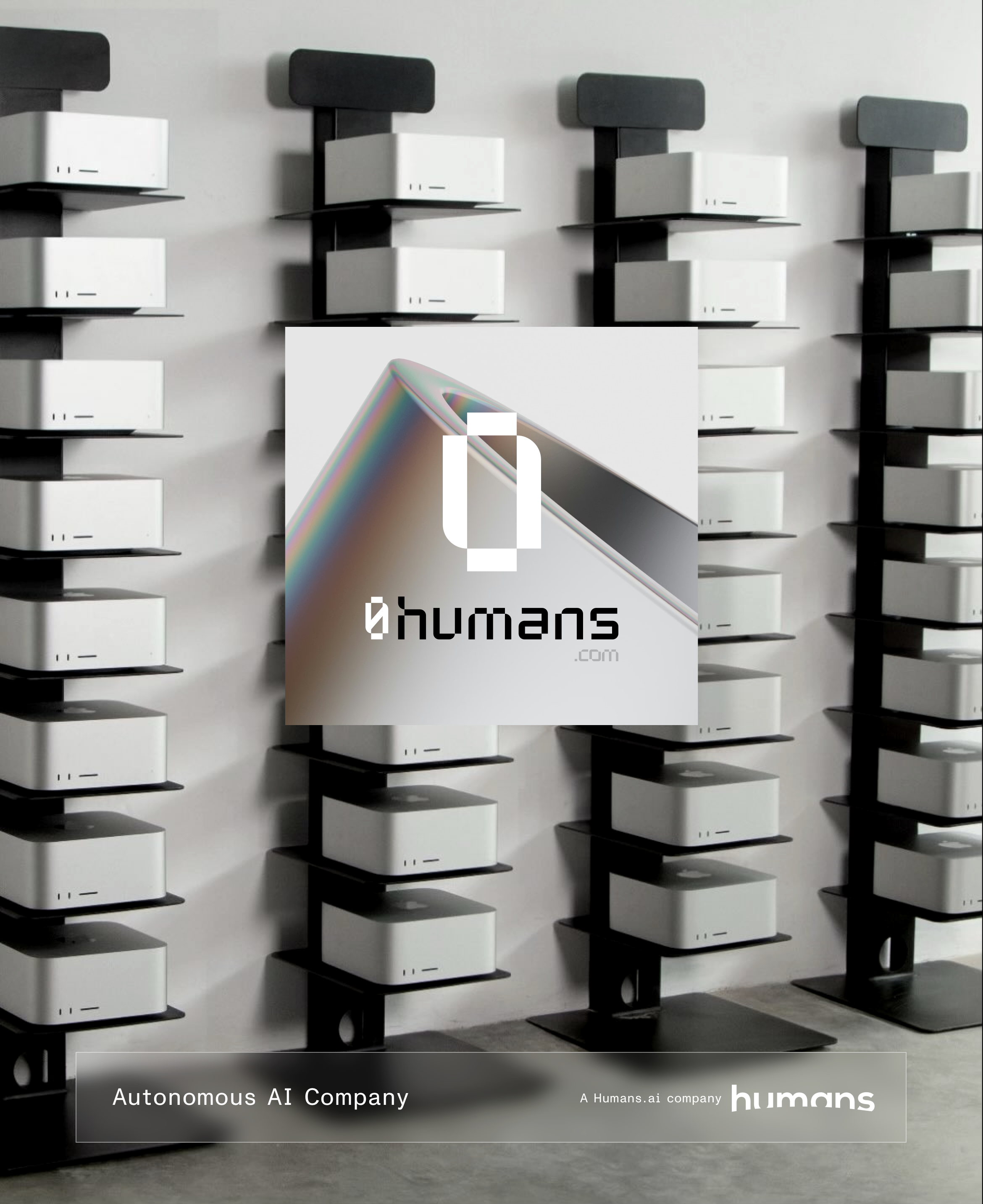
0humans.org is an autonomous AI company with zero human processes. Every department, every workflow, every handoff, every operation designed from day one for machines. No salaries embedded in the price. No management layers. No miscommunication. No turnover. No overhead. What the customer pays for is pure efficiency: the actual cost of producing the work, and nothing else. The result is a company with structurally higher margins, structurally faster delivery, and structurally better output. From zero humans to infinite scale.Humans.ai teaches machines how to think. 0humans.org is a company where they work.
The Machine-to-Machine Era Has Arrived. Humans Are Still the USB Cable.
We have AI that can write production-quality code, design products, analyze markets, create marketing campaigns, handle customer support, and manage projects. We live in a machine-to-machine era.
And yet: the entire economy still runs through human copy-paste.
A person asks an AI for a marketing strategy. Copies it. Pastes it into a doc. Reformats it. Emails it. This isn't a productivity problem. This is an architectural failure. The intelligence is there. The execution layer is missing.
The Numbers That Prove the Model Is Broken
— Dario Amodei, CEO, Anthropic, Davos 2026
Three Shifts in 12 Months
Production Quality Cliff
Anthropic's CEO admitted his engineers use AI to write most code. Gartner forecasts 40% of enterprise apps will embed AI agents by end of 2026. This isn't incremental improvement. It's a capability cliff.
Compute Economics
Apple's M4 Mac Mini: 38 TOPS, €599. A €750K investment buys 500 agents running 24/7. Annual cost per "worker": €2,500 vs Human: €150K. A 40–100x cost advantage that didn't exist 18 months ago.
The Smartest People
"The upper limit is full AI companies." — Sam Altman. a16z predicts "AI stops being something you ask and becomes something that does." The Davos consensus: AI is rewiring the global economy.
But Everyone Is Building the Wrong Layer
Sell tools to companies. Customer does the work using AI.
Sell AI workers to companies. Customer manages and orchestrates workers.
Be the company. Customer receives finished, operating products powered by AI workers.
An autonomous company that can run any business.
We start with the business we know best: building and operating AI products. 500 AI workers run as an autonomous AI agency with 10 senior engineers as Fleet Commanders. The output is not code. The output is finished, launched, operating products, workers, and systems.
Talk with AI Human
No 40-page spec doc. Describe needs in plain language. AI breaks it down into architecture. You approve.
The Factory Builds
500 agents spin up. Design, code, test, deploy — parallel execution supervised by senior engineers.
Launch & Operate
Product goes live. Social, Support, Growth agents activate. We run the product, you run the business.
Price Comparison
| Product | Traditional | The AI Factory |
|---|---|---|
| Simple AI Product / MVP | $50K - $150K | $50K |
| AI Worker Platform | $150K - $400K | $150K |
| Enterprise AI System | $400K - $1M+ | $350K |
| Autonomous AI Product | $250K - $600K | $200K |
Model Comparison
| Metric | Traditional | The AI Factory |
|---|---|---|
| Timeline | 6-12 Months | 2-4 Weeks |
| Scope Risk | High (78%) | Zero |
| Post-Launch | New Contract | Included Ops |
| Workforce | 5-15 People | 500 AI Workers |
Unit Economics
- Infrastructure (500 AI Workers)$500,000
- Engineering Team (10 Seniors)$960K/yr
- Avg AI Product Price$15K - $350K
- Margin85–96%
Why AI Workers Instead of Hiring?
Traditional companies scale by hiring people ($150K/yr each). We scale by deploying AI workers. Each Mac Mini hosts a digital worker that costs $1,000 once and operates 24/7 for 3 years. No salary. No benefits. No turnover.
The marginal cost of the next AI product is near zero. That's the new competitive advantage.
The Market We're Taking
Consumer apps & platforms — the segment where AI products are built, deployed, and monetised at scale.
Consumer apps & platforms market projected for 2030. The layer where AI products live, get paid for, and compound.
A conservative slice of a rapidly expanding market. Achievable because AI Factory scales without the hiring bottleneck.
At 10% market share. Reachable with under 100 people — the only company that can say that.
Source: Gartner, a16z, McKinsey Global Institute — consumer AI app & platform TAM projections 2024–2030.
From Factory to Autonomous Empire
Prove It
Deploy the 500 AI worker factory. Deliver 20–100 finished AI products. Prove that an autonomous AI company can handle the entire lifecycle.
Own the Products
Stop only building for clients. Start building AI products the factory owns. Deploy AI workers across proven markets. Transition from service to AI product company.
Franchise the Model
Package the AI Factory as a turnkey license. Country partners invest in hardware + setup fee. 50-50 profit split.
New Verticals
Partner with domain experts to deploy autonomous AI companies in new industries: Insurance, Accounting, Legal, Marketing.
The Moat is Orchestration
Hardware is a commodity. Orchestration is not. The hard problem isn't running one AI agent — it's coordinating 500 agents across 9 business functions to operate as one coherent company.
"coordination: routing, locking, state management, and policy enforcement across massive parallel execution."
— a16z, The Bottleneck
Institutional Scale
Deployed in sovereign government environments. 12+ month head start.
Data Flywheel
Every project generates operational intelligence. By project 200, we're unreachable.
Model Agnostic
Our IP is the orchestration. We switch models (Claude, GPT, Llama) based on price/performance.
Frequently Asked Questions
"Isn't this just an outsourcing shop with AI?"
No. We own the means of production. We can retain equity, earn recurring revenue, and franchise the model. It's a portfolio of AI-native companies, not an agency.
"How do you ensure quality?"
Three layers: Agent-to-agent review, Fleet Commanders (Senior Engineers) for judgment calls, and automated orchestration gates (tests, security). Quality is systemic.
"Will people pay for AI workers and AI-built products?"
Customers buy products that solve problems. They care about speed, quality, and price. We deliver 10x faster at a fraction of the cost. Gartner forecasts 40% of enterprise apps will embed AI agents by 2026 — the market is ready.
"Why not Silicon Valley?"
Labor economics ($8K vs $25K engineers), proximity to EMEA markets, and a geography-independent factory model.